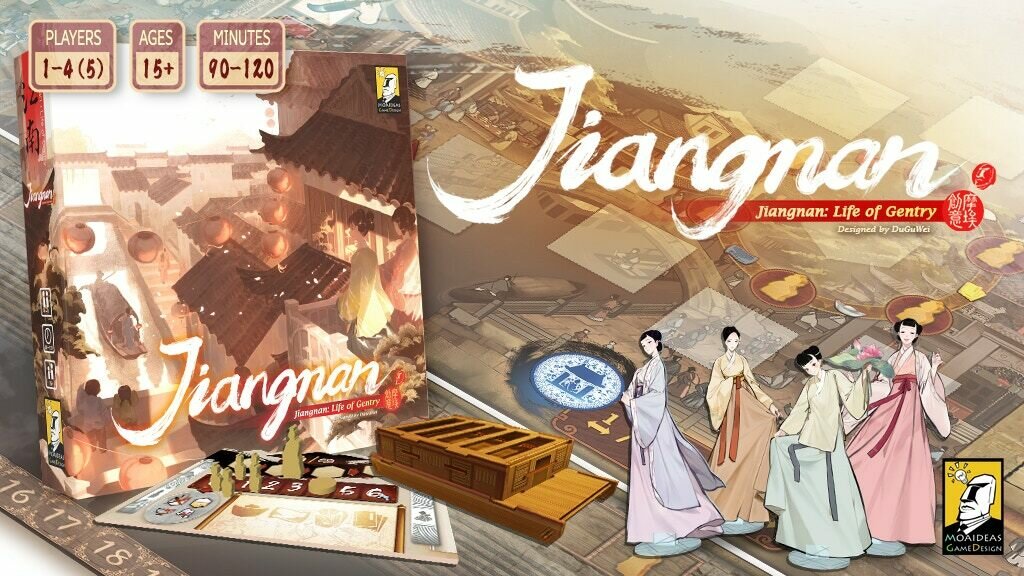
Publish your works and build your destiny in Jiangnan. A worker placement, area control, and bag building game for 1-4 artisans.
Latest Updates from Our Project:
A Path of Inky Deeds
about 4 years ago
– Tue, Feb 01, 2022 at 10:15:45 PM
Wow, aren't we moving pretty fast today? At $40,000 USD, another chapter for Jiangnan is now unlocked! This stretch goal will also be available for all versions of the game.
$40K - Traveling Artisans
Let’s go on a trip and share your masterpiece with everyone! Traveling is always expensive, especially so in the ancient times. This chapter introduces a new way of publishing your works—give them out to pay for your travels!
Next up is a component upgrade. This time I want to try something new, instead of silk-screen printing, we’re going to add a slight engraving on your scholar meeples! This will add depth and should help bring out their character.
Thanks to all of our backers for their pledges! We had an awesome first week, and I am looking forward to the next one!
We are very close to unlocking our Social Sharing Goal, so please click the links below and share them on your profile!
Best Regards,
David Liu Producer @ Moaideas Game Design
Over 500 Backers and $38,000 in 1 WEEK!
about 4 years ago
– Tue, Feb 01, 2022 at 10:20:58 AM
Hello Dear Backers!
The Jiangnan campaign is just our second board game project on Kickstarter, and we are thrilled to reach nearly half of what we funded the first time in just one week! You guys are amazing!
We want to say thank you so much for all the support and sharing on Facebook, Twitter, and Instagram. You are truly helping us unlock the next stretch goal, and we appreciate you so much!
One of the most important stretch goals is already unlocked: All female characters can now be used as a player-controlled avatar to provide Talent abilities for the game.
This is probably the most requested addition to the game we got from playtesting and demos at Essen Spiel. and I am proud to announce that it will be included in all versions of the game.
This may not be historic, but we at Moaideas are also committed to making the board game community inclusive and awesome. Thus we feel it should be best to make this option available, while acknowledging the historical facts in the rulebook.
Social Stretch Goal Progress
Here is how we are moving along with the social stretch goal
Facebook - 21 Shares
Twitter - 27 Retweets
Instagram - 39 💖
The total is now at 87 across all platforms, great job! Only 13 more to unlock characters from A Dream of the Red Mansions!
We want to add character cards for the characters from A Dream of the Red Mansions! Reach this goal, and you can meet characters from the novel as Muses, or play them as your player avatar with Talent power during the game! Click on the links below and share now, your help is greatly appreciated!
Thank you again for all of your pledges and comments for the past week. Your fabulous encouragement keeps us going forward.
Best Regards,
David Liu Producer @ Moaideas Game Design
Geishas and The Eight Beauties of Qinhuai
about 4 years ago
– Mon, Jan 31, 2022 at 11:52:18 PM
There’s no other way to say it. Aspects of Ancient Chinese culture were sexist. There is an overwhelmingly male dominance in society, jobs were mostly limited to men, and a man could have as many concubines as he could afford.
I’m not condoning this. This is a history of how the world existed in the past, but it is not a great reflection of what the future should be. The world has made great strides in the last few centuries toward more equality between men and women.
I bring up this sensitive topic because it is an important part of understanding the world of Jiangnan. Eight of the female characters in our game are based on the legend of The Eight Beauties of Qinhuai, first appearing in a book about famous courtesans who lived in the Jiangnan region during the late Ming Dynasty. (aquick recap, Jiangnan also means "South of the Qinhuai River")
People would tend to think of "courtesan" as a polite word for "prostitute", although originally the word was not used to refer to sex workers. Still, becoming a courtesan is rarely a profession one would willingly choose. In order to avoid controversy, in our game I have decided to call them as Muses.
This is because throughout history, these women were commonly subjects of poetry and songs or quoted as their muse of inspiration by literati scholars & artisans.
During the game, you may also pay visits to these creative and knowledgeable women to gain inspiration for your next big release, and perhaps earn enough favor for the privilege of hiring them for your studio.
Why not Geishas?
While researching alternative terms for "courtesan," one of the first to come to mind was "Geisha," but I soon decided against using it. Geishas are Japanese — not Chinese — which would probably open another can of worms.
Geishas were mostly praised for their artistic talents and less so for their sexuality. The Eight Beauties of Qinhuai are basically Chinese equivalents of geisha, as they are not only skilled in literature, poetry, fine arts, dancing, music, and conversation but were also highly praised for it—more so than their sexuality. Still, geishas and their Chinese equivalents could become “reserved” or “kept” mistresses, often by wealthy or influential individuals.
It’s worth noting that the Japanese kanji for Geisha is “芸者”, which originates from the Chinese characters “藝” (meaning “art”) and “者” (meaning “person” or “doer”). Another term for Geisha is Geigi (芸妓), and the second character “妓” (meaning “prostitute” in Chinese) may be part of where the confusion comes from.
The Japanese use the character “妓” because it is also the female form of the character “伎” meaning “performer”. Labeling geishas as prostitutes is totally wrong as the profession have few similarities to the definition of “prostitute”. Also, the Japanese language uses other characters when referring to sex workers.
Chen Yuanyuan (陳圓圓) is known for her singing & dancing, and was credited to lead roles in opera houses.
Jiangnan,South of the QinhuaiRiver
In contrast to women of the upper gentry class who were often discouraged from cultivating skills outside of childrearing, courtesans were often highly skilled in literature, poetry, fine arts, dancing, music, and conversation—and may even outperform men. Additionally, many female poets or artisans in Chinese history are likely to be trained as courtesans—the few expectations would be those born into scholarly families.
No better example of this exists than the Eight Beauties of Qinhuai.
These courtesans were so famous in their day that 100 years after their death, numerous works werestill created about them—novellas, operas, poems, and paintings. Much like the geishas across the ocean, the Eight Beauties of Qinhuai have been praised for their artistic talents—these women are highly educated, and may even own property and publish literary works of their own.
Some may not want to call The Eight Beauties of Qinhuai as geisha because they weren’t Japanese, but I would argue that they have many similarities.
Statue of Chen Yuanyuan (陳圓圓). Her role in the demise of the Ming Dynasty is greatly exaggerated in popular lore.
However, academics debate whether all eight of these women actually existed. They might have been works of fiction, or they could have been amalgams of several women from history. But their names appear again and again throughout Chinese literature and they are celebrated for their talents. Statues commemorating them are still made today, 500 years after their death.
I hope you’ve learned a little bit more about the world of Jiangnan, which will hopefully add to your enjoyment of our game. This is a delicate subject and I wish you can join in the discussion.
Best Regards,
David Liu Producer @ Moaideas Game Design
You are doing great! Fourth SG unlocked!
about 4 years ago
– Mon, Jan 31, 2022 at 04:48:01 PM
Hello Dear Backers!
It hasn’t even been a week since our launch, and we have already made great progress! At $35,000 USD, we reached our fourth stretch goal, so we can now include more action tiles for you to draft in the second round!
$35K - Extra Action Tiles II
This will be a great boost to the variety of strategies you can adopt during the game. An excellent way to add variety to the game and keep it from growing stale. Be a flexible literary giant!
Coming up next is another new Chapter! Traveling is always expensive, especially so in the ancient times. This chapter introduces a new way of publishing your works—give them out to pay for your travels!
Social Stretch Goal Progress
Here is how we are moving along with the social stretch goal:
Facebook - 15 Shares
Twitter - 25 Retweets
Instagram - 33 💖
The total is now at 73 across all platforms, great job! Only 27 more to unlock characters from the Dreams of the Red Chamber!
We want to add character cards for the characters from Dream of the Red Mansions! Reach this goal, and you can meet characters from the novel as Muses, or play them as your player avatar with Talent power during the game! Click on the links below and share now, your help is greatly appreciated!
Thank you again for the awesome support. We will always remember we could not have done this without you.
Best Regards,
David Liu Producer @ Moaideas Game Design
Graphic Updates
about 4 years ago
– Fri, Jan 28, 2022 at 11:28:41 PM
You may have noticed that some components on the campaign page look different from those used in photos and reviews. This is because those prototypes were made back in mid-2021, and so they are from an earlier version.
For the past few months, we have been working hard to improve the graphic design on the boards, and we will continue on reworking the character & portfolio tiles next. Please have a close look of the changes below. Or even better, check them in action in this livestream by Gaming Rules!
We experimented with different ways of making the icons more catching to the eyes while being thematic, and we ended up with Ming Vases. In the first 100 years of the Ming Dynasty, the porcelain manufacturing industry saw dramatic improvements in both the manufacturing process and technology. Hence, we went with the traditional look of blue and white.
The black & white action icons are also redrawn in color, and used across the game.
The upkeep board has been completely redesigned from the prototype version, and also combined to save space. The turn order track was moved to the top of the Society so it would be more convenient to use, as it's the first thing you do when visiting that location.
The best touch is the reordering of the upkeep step icons to a vertical column, as it makes everything seem simpler and more intuitive. Also, covering reminder icons specific to a certain round is a stroke of genius. Previously, it was often misunderstood that the trends of the first 2 rounds are always worth 2VP, but covering it up makes it clear that they will instead be worth 3VP in the 4th round, and 4VP in the 6th round.
The icon placement on the player boards was streamlined by our game developer, and our graphic designer was able to blend everything together in a visibly pleasing way.
The upkeep reminder icons were moved to the upkeep board, and the stress/sprits track was swapped with the personal supply area so it would not get easily bumped during the game. We also observed that players tended to sort the colors into groups and line them up single file to easily keep track of their inventory, so placing your supply below the player board provides the space needed.
The Boats Must Flow
Finally, here is a mock-up of the cardboard party boat of the deluxe edition!
It is designed in the likeness of a covered riverboat that is a restaurant or can be used to hold parties. Even today, you can still find fancy restaurant boats like this on the rivers of Hangzhou & Asakusa.
Thematically, the scoring trend that gets decided on the boat is proclaimed as the latest fashion in Jiangnan, which will then flow throughout the city and down the river, eventually spreading throughout the rest of China, and may even influence other Eastern Asia cultures like Korea and Japan.
This majority/area control aspect of Jiangnan is really important, as the winner can decide which trend gets scored multiple times during the game, so it is something we really want to deluxifiy.
Thanks for reading!
That's all for now, I really hope you enjoyed this look into the making of Jiangnan!
What do you think of our graphical updates? I would love to hear from all of you.
Best Regards,
David Liu Producer @ Moaideas Game Design